Ricky Ribeiro, svp, creative director, Manifest
There are a thousand legitimate reasons why your marketing plan didn’t have hardcore metrics like pipeline sales or lead scoring baked into it. Feel free to take your pick:
- Maybe the tech team has refused to prioritize integrating the lead-gen tool?
- Maybe you don’t have the plug-in you’d need to connect to the company’s CRM to tell that story.?
- Or even if you did have those tools, the data coming out of them is flawed and hasn’t always matched reality.
While you might have a good reason for not having the data, that justification never really bridges the gap between marketers and many business leaders, because what leadership is ultimately asking is simple: “Is this working?”
THE SEARCH FOR VALUE IN A MESSY MARKETING LANDSCAPE
So here are my two cents: Instead of wrapping yourself up in justifications, grapple with this marketing truth instead: Your boss doesn’t care about impressions. They care about impact.
Impact is marketing’s pot of gold at the end of the rainbow, and it isn’t measured in a single metric. It’s an intangible, nuanced, messy, psychological belief and feeling that any good marketer aspires to manifest (pun FULLY intended) with their audiences — both internal, like your boss and their bosses, and external, like the customers and prospects you’re trying to reach.
Before you roll your eyes and assume I’m a typical creative type who wants to dismiss quantitative data in favor of qualitative, hear me out. I love data. I actually believe there are important stories hiding in datasets and spreadsheets.
And while some of the value of your marketing activities will come through in the KPIs you set and define, the truth is, a lot of lasting perception of your marketing’s value will come through in how you connect, engage, and sell your ideas and creative to your stakeholders internally.
As a creative leader, I rely on my partners in data intelligence to help me align my ideas with what will be measured, and how I can tell that story to my leadership internally or to my clients.
Establishing Metrics of Success Is More of a Group Act, Not a One-Man Band
It’s super easy to pick on so-called vanity metrics like impressions or page views, but there’s nothing wrong with those metrics in and of themselves. The problem is leaning on them alone as a proofpoint of success and impact. They’re useful contextual data, but they can’t carry the full weight of why a leadership should believe your marketing is working or worth continued investment.
Working alongside our data intelligence team, I’ve come to see the biggest misconception marketers hold is the idea that they’re one metric, one platform, or one tech-stack change away from finally proving their program’s success. Instead, marketers must figure out what combination of metrics can actually tell the story that needs to be told, and holds you accountable to more than just pointing at rising impressions.
Part of the reason some marketers end up backed into the impressions corner is because they don’t have a data intelligence partner. This might be because that expert isn’t on your team, or, even if they are, perhaps you aren’t involving your analytics team early enough or intimately enough to alter the way you tell your impact story. Too often, data only enters the conversation at the very end, once someone asks “how did we do?” By then, all you can show is whatever happened to already be set up.
So what might a good combination of impact metrics look like? Here are a few suggestions I picked up in talking with our data intelligence team:
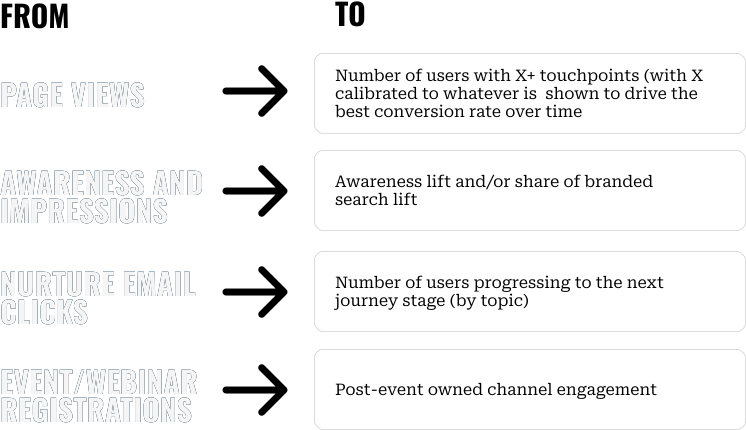
- Pair page data with some form of conversion data. If someone hits five content touchpoints before moving further in their journey, you can say something like, “we increased the number of people hitting that threshold by 15% month over month.” That shifts you from a pure vanity metric toward a real narrative, one that connects page views to behavioral cohorts to conversion rate.
- If you’re focused on brand lift or awareness, layer your data iteratively across the journey (research, evaluation, conversion, post-purchase) and let it surface where things break down. If unaided awareness is struggling even as other metrics look healthy, that can point to a memorability problem: Perhaps you’re generating visibility and brand interactions, but people simply aren’t retaining it.
And those are just a couple of starting points. Here’s a broader shift I’d encourage marketers to make as they move away from these metrics and toward ones more likely to land with leadership:
Measurement Plans and Journey Maps Point Marketers in the Right Direction
As a content and digital agency with deep experience across industries, we know measurement is a nuanced, context-dependent conversation. As part of any client engagement at Manifest, we build measurement plans for campaign creative and content programs. These plans are thoughtful and strategic, centered on understanding the client’s business well enough to know how to actually measure and optimize value.
The crafting of a measurement plan always starts with candid conversations and a workshop around the business goals, making sure everyone’s aligned, and getting a clear read on how the client is already measuring success, since most teams have something in place. From there, it’s a back-and-forth, as we identify the gaps and figure out the best way to close them.
We saw this recently with a client who hadn’t yet integrated form submits into their site analytics. To close that gap, we worked with them to build KPIs capturing the journey from impressions all the way to the key CTA engagements right before conversion, leveraging their existing site tracking ahead of a Marketo implementation still in progress.
Beyond measurement plans, we also invest heavily in customer journey analysis, pairing data with the actions marketers can actually take in response to it. At a more advanced level, this is where a platform like our own Manifest Orchestrate comes in. This tool provides identity resolution and visibility from the very first impression, tracked all the way through conversion, and paired with the ability to hit the right person with the right creative at the right time.
One reason journey analysis matters so much is that the top and bottom of the funnel tend to get all the attention, while the messy middle, where the hardest marketing work actually happens, gets overlooked. That’s exactly where a tech-driven, sophisticated approach pays off, since it’s imperative that you ensure the repeated brand interactions you’re facilitating are actually translating into the business outcomes you want.
Consider This as You Build Your Content Success Plan
If you’re tired of dying on the impressions hill, here are a few meaningful next steps you should consider as you develop your success plans:
1) Start with the business goal that your boss WOULD be happy with. That may mean educating your boss on what is and isn’t measurable, and aligning your tactics with what’s measurable, budget, and any other constraints baked into your plan. The why matters as much as the what.
2) Connect how your initiative impacts or influences that biz goal. The goal isn’t to force your measurement plan or your marketing strategy to follow a rigid journey or user flow. It’s to make sure every user journey or flow is possible and ensure those journeys are working harder for your marketing plan and, ultimately, your organizational objectives.
3) Think outside the box with KPIs. Don’t just pick from a predetermined list. The From/To table above is meant to jump-start your thinking, not box it in. Without direct engagement, any outside expert is blind to your organization’s nuances. If your impressions underperformed, dig into why: did most of them come from decision-makers at your target accounts? If so, those “meager” impressions might be far more valuable than the raw number suggests.