Leverage Google Analytics to track AI-driven search behaviors and a strong content strategy to establish your brand in search results.
Imagine knowing exactly how AI tools are driving traffic to your website — and using that insight to optimize your business strategy. While AI search engines may seem like a black box, there’s a wealth of trackable data waiting to be uncovered. As marketers and data enthusiasts, we like to dig deeper and ask the right questions to uncover why certain trends are emerging.
Read on to learn how to leverage Google Analytics to track AI-driven search behaviors, gain clarity on AI audience trends, and unlock valuable insights to shape your strategy and measurements moving forward.
How Users Get from Generative AI Engines to Your Website
Referral traffic from generative AI engines is tracked differently from search engines that incorporate AI Overviews (AIO) like Google and Bing.
Think of AI-driven traffic as coming from two types of sources: virtual tour guides and personal concierges. AI Overviews (AIOs), like Google or Bing’s AI features, act as tour guides, curating a custom itinerary of links from trusted sources and directing users to your site as part of their journey. In contrast, generative AI engines like ChatGPT, Claude, Gemini, and Perplexity function more like personal concierges. They provide direct answers but may include your website as a “recommended reading” link for additional context.
As with most travel, having a concierge and a tour guide provides the best results, which probably explains why users are increasingly turning to both. After all, this approach doesn’t just help you figure out what you’re looking for, but also how to get there.
But first, let’s touch on how to set up tracking AI traffic.
How to Track AI-Driven Search Traffic in Google Analytics
It seems like there are more web analytics platforms available now than cat videos on the internet. Take a look at these simple steps to set up your own measurement system for AI-driven traffic with some of the most common options: Google Analytics 4 and Adobe.
Google Analytics
1. Open Google Analytics 4
2. Navigate: Admin > Data Settings > Channel Groups
3. Enter “Group Name” — we used “Channels”
4. Enter “Channel Name” — we used “AI-Driven Search”
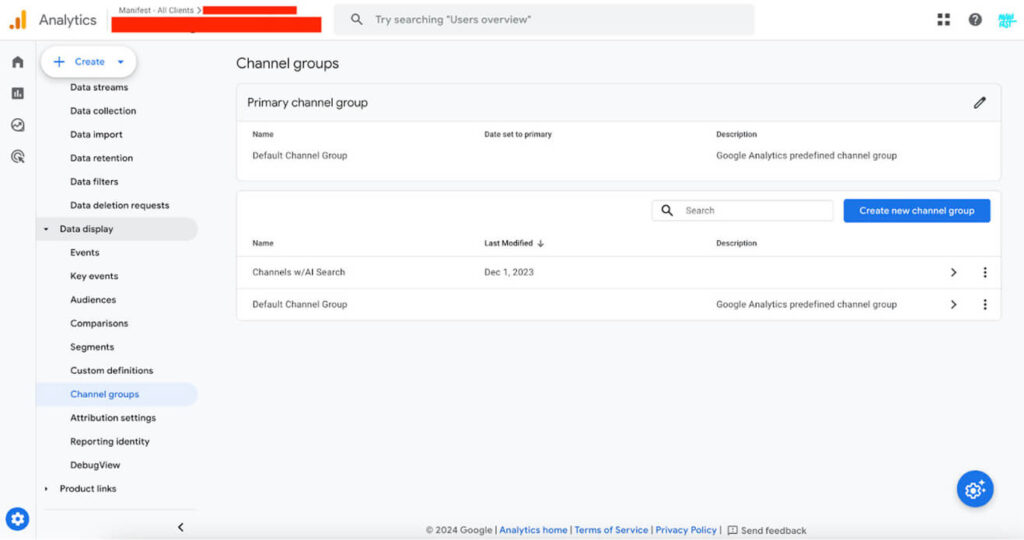
5. For conditions, use “matches regex” and copy / paste this regex formula:
.*(chatgpt|perplexity\.ai|saigroup\.ai|rhythmx\.ai|allclues\.ai|newsletter-preview\.daily\.ai|komo\.ai|deep-medical\.ai|sana\.ai|anews\.stockmark\.ai|gretel\.ai|jasper\.ai|portal\.tracer\.ai|techmonitor\.ai|fob\.ai\.cc|you\.com|socratic\.org|huggingface\.co|claude\.ai|anthropic\.com|gpt|(google.*bard|bard.*google)|neeva|writesonic).*
Because new AI tools are emerging every few months, it’s best to revisit this regex criteria from time to time to be inclusive of the most meaningful tools.
6. Save channel
ADOBE
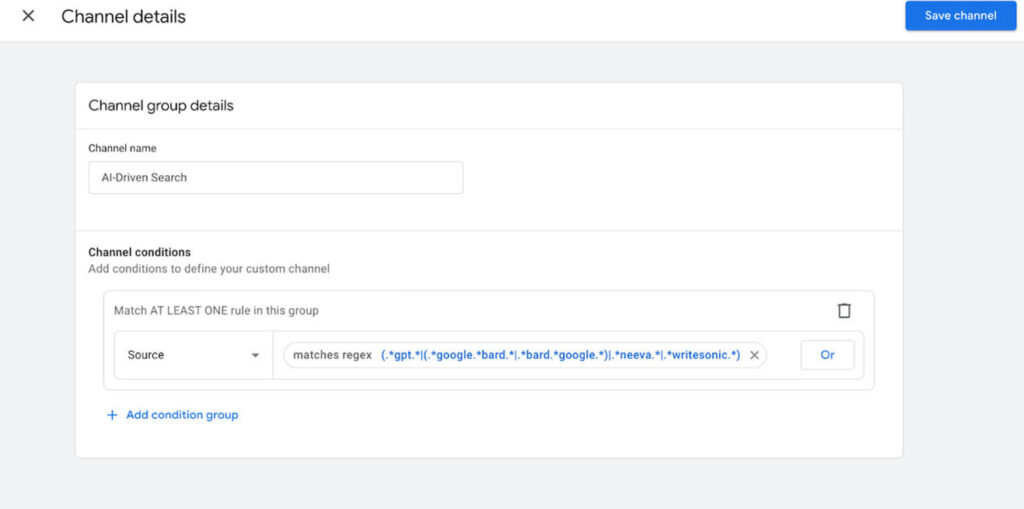
Setting up tracking in Adobe is similar but comes with its own set of nuances.
1. Create a segment — we named ours “AI Traffic” 2. In the definition, leverage the dimension “Referrer” 3. Instead of regex that we used in GA4, we’re using text separated by spaces 4. Once the segment is saved, you can apply to a workspace
Copy / paste this to account for AI sources coming to your website:
chatgpt perplexity.ai saigroup.ai rhythmx.ai allclues.ai newsletter-preview.daily.ai komo.ai deep-medical.ai sana.ai anews.stockmark.ai gretel.ai jasper.ai portal.tracer.ai techmonitor.ai fob.ai.cc you.com socratic.org huggingface.co claude.ai anthropic.com gpt google.*bard bard.*google neeva writesonic
The Challenges
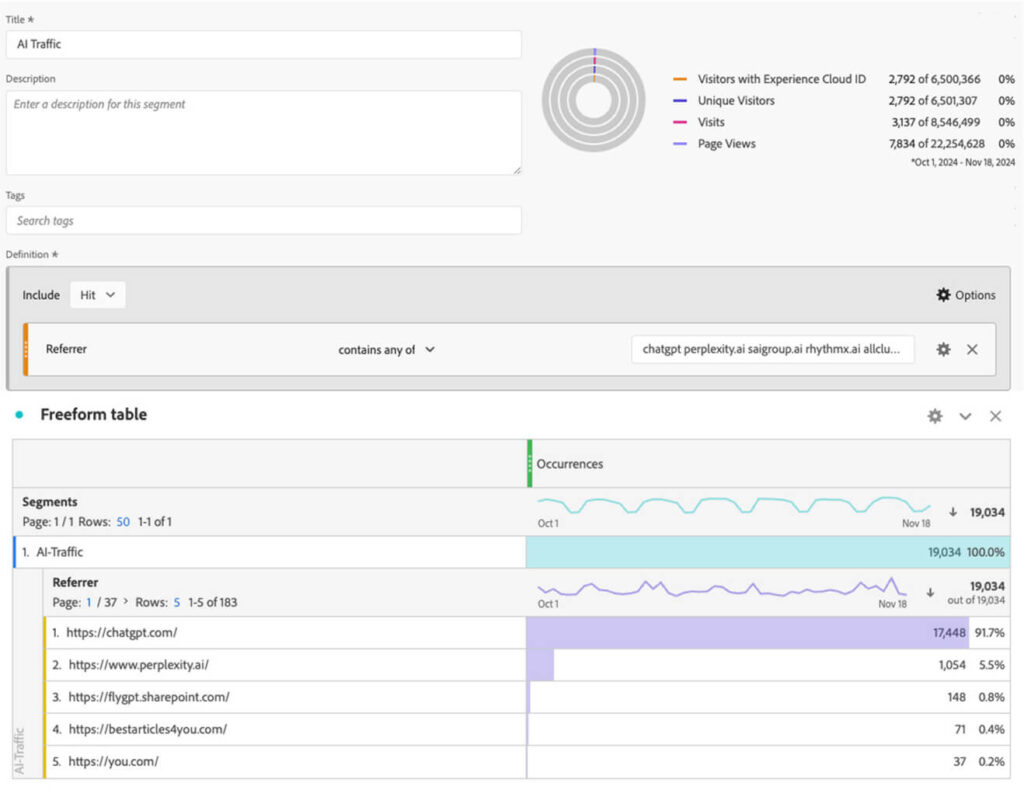
Now that you know how to track AI-driven traffic, what do you do next? Marrying generative AI engine referral data with Semrush AI Overview data provides a fuller picture than we could get six months ago. Brands can see what pages are being pulled into AI Overviews and adjust their strategy accordingly.
The picture this combined data provides is still incomplete, however, because marketers do not know what people are prompting gen AI engines with. A world where ChatGPT or Perplexity user query data is available (similar to Google Search Console) would close this data gap. Because raw numbers can be misleading in isolation, as they don’t account for context, brands should use the combined data directionally, with less emphasis on raw numbers and more emphasis on growth patterns and trends.
The industry wants to know how to reverse engineer the ranking process (calling it generative engine optimization, or GEO), but there’s a lot of nuance in these uncharted AI waters. Here are some considerations before diving in:
Differences Between How AI Models Operate
Each AI platform provides different results.
Gemini, Perplexity and ChatGPT all use retrieval-augmented generation (RAG) for information retrieval. RAG is a generative AI architecture that augments a large language model (LLM) with fresh, trusted data retrieved from authoritative internal knowledge bases and enterprise systems, to generate more informed and reliable responses.
GPT-4 and PaLM use preexisting knowledge stored within their training data, supplemented by external retrieval tools when needed (e.g., browsing data or APIs). Meaning responses might be less current or contextually precise unless they explicitly pull information from a trusted, up-to-date source.
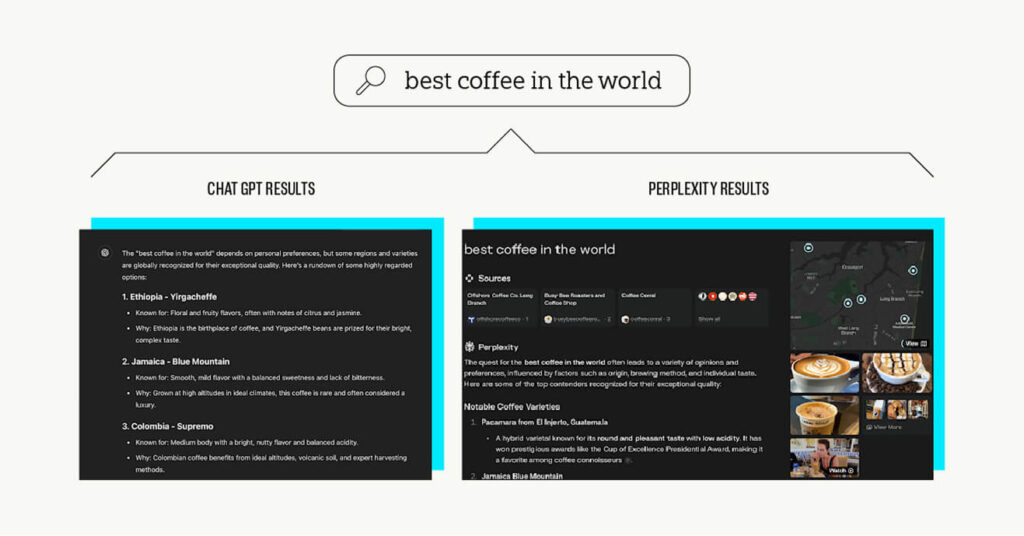
Example from ChatGPT for “best coffee in the world”:

Compared with Perplexity results for the same query:
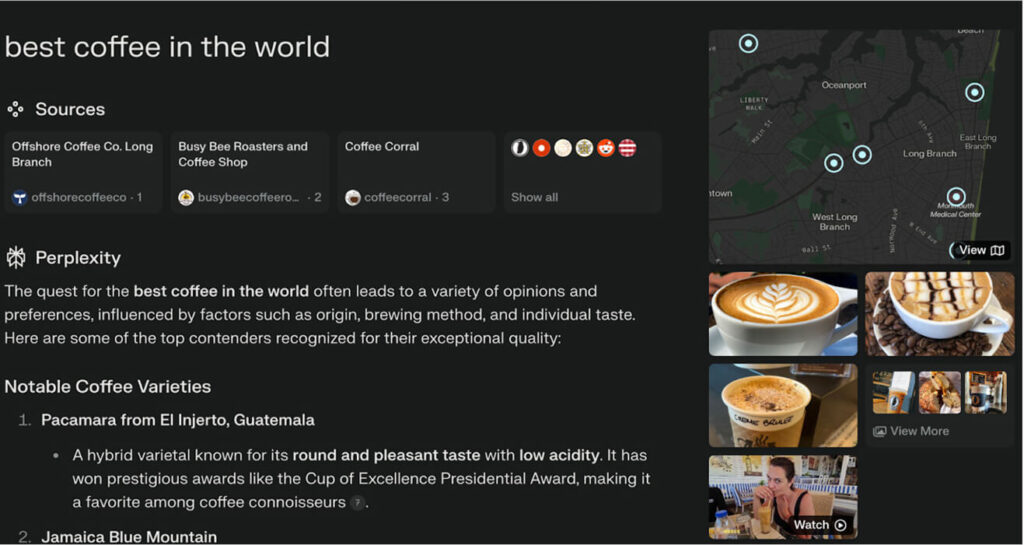
That said, we all know the real answer:

Too Personal
Due to personalization, each user may get different results when using AI search. LLMs often rely on prior interactions to tailor responses. In addition, some LLMs are fine-tuned to specific tasks or users. If the system is designed for a particular domain (e.g., customer service, marketing copywriting), it can adapt its responses to be more helpful based on that context.
We like how Jason Tabeling suggests shifts in query length as more consumers use AI search.
AI Search Results Are Constantly Changing
The first version of ChatGPT was not connected to the internet. But OpenAI’s ChatGPT search, which is connected to the internet and lets users select it if they want the latest information from web sources, allows for more up-to-date information.
Identifying Growth Patterns and Trends
Since beginning to track AI-driven traffic, we’ve noticed some trends when comparing data from different industries.
For clients in the technology industry, traffic from AI increased at an average 14% per month since January 2024. On the other hand, gains seem to be slower for clients in the marketing services industry, where AI-driven traffic accounted for .03% of total traffic.
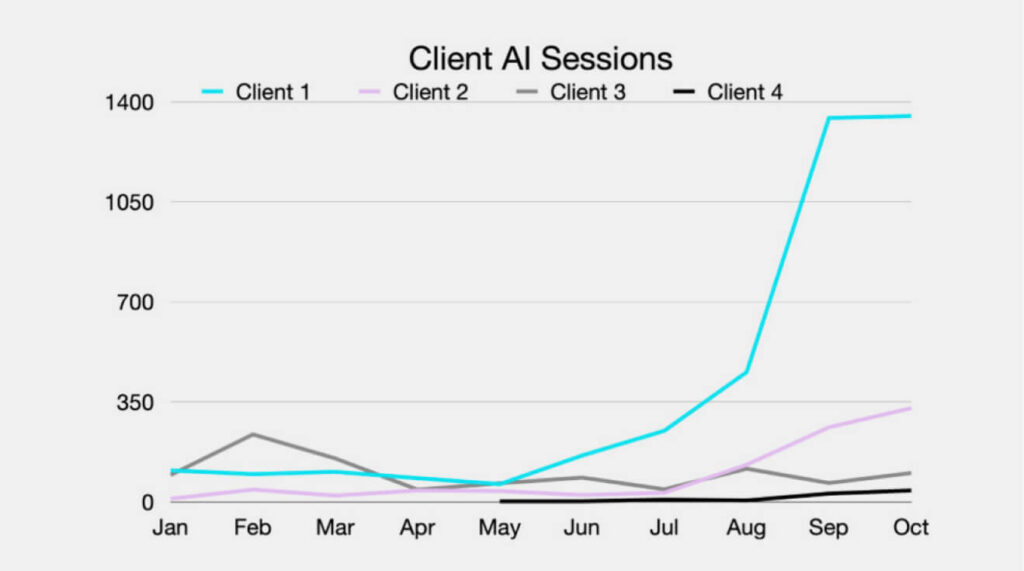
Compared with a year ago, traffic has grown for all of the websites analyzed in our case study, with a significant bump in August. The pages benefiting most from AI search traffic also mirror top performers in organic search. It’s too early to tell whether the AI search traffic is siphoning traffic away from traditional organic search in a meaningful way. Zooming out for context, clients are seeing that around <1% of total website traffic originated from AI search. While impact may be low now, that is likely to grow as more people gain access to AI search.
AI Users Are Increasingly Mobile
According to Similarweb, a data intelligence firm, worldwide desktop and mobile website visits to the ChatGPT website decreased by 4% to 121.3 million in August 2024 following approximately 10% drops from each of the previous two months. Despite these declines, you may have noticed referral traffic from AI sources surge during this time across all industries. This timing lines up with when AI Overviews on Google were released worldwide.
But according to Similarweb, August worldwide unique visitors ticked up to 180.5 million users from 180 million. So how can users and referral traffic increase, but website traffic decline?
OpenAI also released the ChatGPT app on the iOS system in May, which likely sapped some traffic from its website, but these users were still active on their mobile devices. An upward trend continues with daily active users in the U.S. up 19% MoM and 258.3% in October.
AI Search Best Practices Are Similar to SEO Best Practices
You may have noticed that pages that are performing well in AI search mirror top-performing content in organic search. Which begs the question: How is SEO and optimizing for AI-driven search different?
In a recent Search Engine Land article, Christina Adame of Intero Digital calls it generative engine optimization (or GEO). Regardless of what people are calling it, let’s get into how brands are standing out in AI search.
A lot of traditional SEO best practices seem to be prioritized in AI results so far:
- Content quality and relevance: Both SEO and AI engines emphasize high-quality, relevant content that meets user needs and adheres to E-E-A-T (experience, expertise, authoritativeness and trustworthiness) principles.
- Ordered and unordered lists: Numbered and bulleted lists (like the one you’re reading right now) enable readers to better digest information.
- Structured data markup: Elements like FAQs or “how to” formats make it easier for search and AI search engines to recognize portions of your content.
- User Experience: Images, video, maps, graphs and other graphics keep users engaged.
Content Design Is More Important Than Ever
The prioritization of these on-page elements tells us that content design is more important than ever. Content design is a term coined by Sarah Winters, founder of Content Design London, while working for the U.K.’s Government Digital Service, which designs and develops the country’s digital products. For the uninitiated, content design refers to using data and evidence to give the audience what they need, at the time they need it and in a way they expect, according to Winters.
Christina Adame says that content design means that AI search engines will naturally single out content that is structured and formatted to the way people process language.
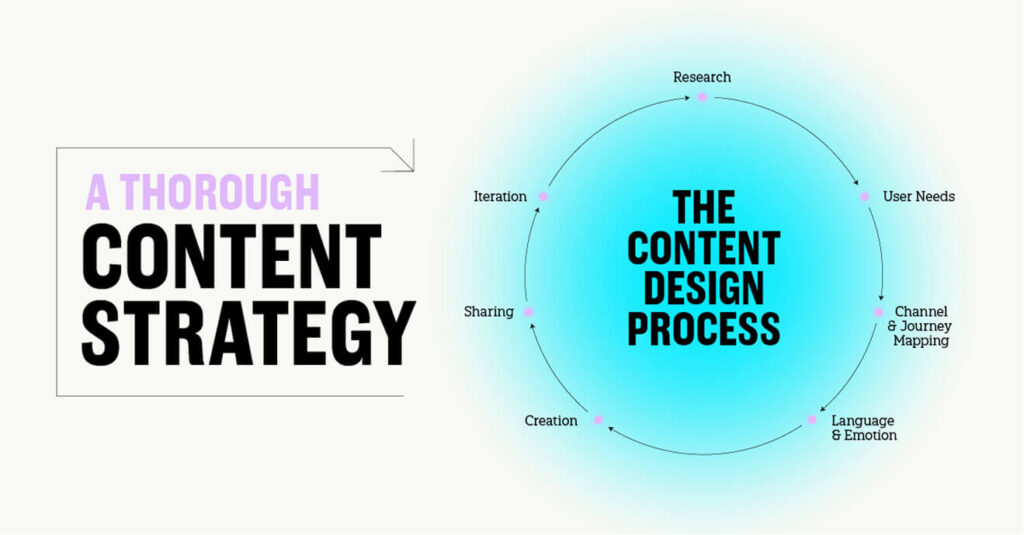
A thorough content strategy that utilizes the content design process looks like this:
1. Research
2. User needs
3. Channel and journey mapping
4. Language and emotion
5. Creation
6. Sharing
7. Iteration
What this means for brands is that a strong content strategy that incorporates user experience, concise copywriting and decisive content distribution has and will continue to provide results for content creators and businesses.
Context Matters
Some things have not changed: People use search to find answers to questions, whether AI-driven or not, and search engines try to contextually pair them with what they’re looking for.
Contextual search takes into account several variables, including browsing history, historical behavior and user intent.
You may have noticed that content pages are being prioritized over product pages. This is likely because users are looking for answers to questions surrounding a product or service. In our analysis of five different industries, 98% of AI-driven traffic was directed toward content or informational pages.
Content pages that answer FAQs or how to implement a product or service provide much more value throughout the buyer journey compared with a rudimentary product page.
What this means for brands is that helpful, organized content remains a powerhouse when reaching customers and influencing their decisions.
Brave New World
AI-driven search traffic is an uncharted frontier, and many marketers and businesses are curious about how this audience and shift in consumer behavior will impact their bottom line. Adapting to new business environments starts with setting up the right data infrastructure and asking insightful questions. So we hope that by following the steps we’ve outlined above, you can stay one step ahead of competitors, maintain your relevance, and better understand the digital universe.